
Celebrating 26 Years of IPSR
Join our journey
Alex
Senior Technical Consultant
- Dec. 10, 2025
Cybersecurity 2025 → 2030: The Talent Gap Is Your Biggest Opportunity
As we reach the end of 2025, one fact is shaping every conversation from Silicon Valley boardrooms to BFSI hiring desks in India:
The world does not have enough cybersecurity professionals — not even close.
Cloud adoption is accelerating at record speed.
AI-powered threats are emerging faster than defenses can evolve.
Everything from classrooms to hospitals, banks, travel, payments, and governance is now digital-first.
Yet, ironically, the number of people who can defend this digital society has barely grown.
This mismatch between cybersecurity demand and available talent has created one of the biggest opportunity waves of our generation. Whether you’re a student, early-career professional, or someone looking to switch fields, the next five years will be the strongest decade in cybersecurity’s history.
Let’s explore the numbers, the trends, and the reasons that make 2025 → 2030 the golden era of cybersecurity careers.
The 2025 Cybersecurity Reality: A Global Talent Crisis
The ISC2 Cybersecurity Workforce Study (2024) — considered the most authoritative global research on cybersecurity jobs — reports:
- 5.5 million cybersecurity professionals worldwide
- 10.3 million required to keep organizations safe
This leaves a massive, unprecedented gap of:
➡️ 4.8 million unfilled cybersecurity jobs (2025)
This gap represents:
➡️ ~47% of the total cybersecurity workforce needed globally
.jpeg)
This isn’t just a hiring challenge.
It’s a structural global risk.
Public and private sectors from national defense to fintech and healthcare are openly admitting that they cannot find enough trained cybersecurity professionals.
The shortage is particularly severe in countries like the United States, Canada, UK, India, Singapore, Australia and the entire EU region.
Workforce Growth Has Stalled — And That’s a Bigger Problem
One of the most alarming findings from the ISC2 First Look Report (2024) is that:
➡️ Cybersecurity workforce grew only ~0.1% in 2024
That’s effectively zero growth.
Compare this with what’s happening globally:
- Cyberattacks increased by over 65% in 2024 (Check Point Report)
- Ransomware volume grew by 26% YoY (SonicWall Threat Report)
- Cloud workloads increased massively across industries
- AI-powered phishing surged dramatically
- Global compliance standards tightened
In other words:
Cyber threats → UP
Cloud expansion → UP
AI attack tools → UP
Security workforce → FLAT
This imbalance is unsustainable and it’s the reason cybersecurity jobs are becoming some of the easiest paths for beginners to get into tech.
Cybersecurity Market Growth: A Multi-Billion Dollar Boom
While talent is scarce, investment in cybersecurity is skyrocketing.
The Fortune Business Insights (2024) report shows:
- 2025 market size: ~$218.98 billion
- 2032 projection: ~$562.77 billion
- CAGR: ~14.4%
This is one of the highest growth rates in the tech sector — higher than many cloud, automation, and AI verticals.
.jpeg)
Cybersecurity is rapidly becoming a top-budget priority rather than a supportive IT function.
Companies Are Hiring Faster Than the Talent Pipeline Can Grow
Recruitment studies across ISC2, Forbes Technology Council, and CyberSeek (US) reveal a consistent trend:
Companies simply cannot find enough job-ready cybersecurity talent especially in specialized domains.
Here are the most talent-starved roles in 2025:
High-Demand Roles (2025–2026)
- Cloud Security Engineers
- AI/ML Security Analysts
- Pentesters & Ethical Hackers
- Incident Responders
- Zero Trust Architects
- Identity & Access Management (IAM) Specialists
- SOC Analysts
- DevSecOps Engineers
.jpeg)
Organizations are no longer looking only for “high-level experts.” They want learners, “fast adaptors,” and “hands-on beginners” who can grow into these roles
The Era of the Beginner: Why Freshers Are Now in Demand
The most exciting insight comes from the ISC2 Cybersecurity Hiring Trends Report (2025):
➡️ Over 60% of early-career roles do NOT require previous experience.
This is a dramatic shift.
Companies have realized:
- Talent can be trained on the job
- Foundational skills matter more than expertise
- Practical labs > theoretical knowledge
- Diverse backgrounds strengthen cybersecurity teams
- Beginners bring adaptability and curiosity
This shift means:
✔ Non-IT students can enter cybersecurity
✔ Career switchers can start fresh
✔ Fresh graduates have a real advantage
✔ Hands-on training is more important than degrees
For young learners, this is the best moment in history to step into cybersecurity.
2025 → 2030: Why These Next Five Years Are the “Golden Era”
When global hiring shortages, exponential cyber threats, and massive market growth converge — you get a career landscape unlike anything before.
Let’s break down why:
Trend 1: The 4.8M Talent Gap Is Not Closing
Even if training pipelines doubled, demand would still outpace supply.
Trend 2: AI-Driven Cyberattacks Are on the Rise
Attackers now use AI to automate:
- phishing
- malware generation
- credential stuffing
- vulnerability scanning
Security roles must evolve fast — and fresh talent is essential.
Trend 3: Cloud-First Architectures Are Everywhere
9 out of 10 companies run workloads on AWS, Azure, or GCP.
Cloud security skills are becoming as basic as email skills once were.
Trend 4: Compliance Pressure Is Expanding
Governments in the US, EU, India, UAE, and APAC are rolling out new cybersecurity and data protection laws.
Organizations must hire cyber professionals — or face penalties.
Trend 5: Cybersecurity Offers Stability in an AI-Disrupted Job Market
AI may replace repetitive jobs, but cybersecurity roles require:
- human judgment
- creativity
- investigation
- ethical decision-making
These cannot be automated entirely.
Trend 6: Cybersecurity Has Become Borderless
Work-from-anywhere.
Global roles.
International certifications.
Remote SOC teams.
A career in cybersecurity is now location-independent.
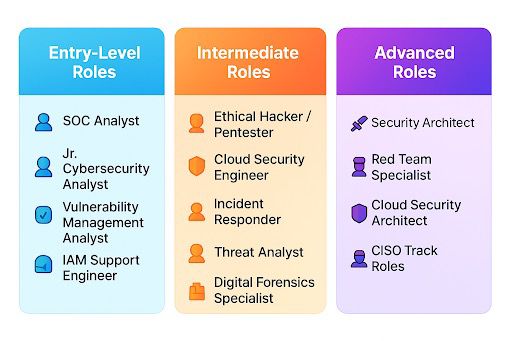
What Cybersecurity Careers Look Like for Beginners (2025–2030)
Cybersecurity is not one single path, it’s a network of opportunities.
.jpeg)
This diversity ensures that whether you like coding, investigating, cloud tools, AI, or problem-solving — there is a path for you.
Start Now — Because the Opportunity Window Is Wide Open
You are entering the market at the perfect time:
- The skill shortage is massive
- The investment pipeline is growing
- The industry is beginner-friendly
- The global market is booming
- The jobs are meaningful and high-impact
2025 → 2030 will define the new generation of cybersecurity leaders.
The question is:
Will you be one of them?
Start your journey. Step into a career where the world truly needs you.
Enroll Now: https://www.ipsr.org/course/cyber-security-peneteration-tester-course-kerala
References
- ISC2 Cybersecurity Workforce Study 2024
- ISC2 First Look Workforce Insights 2024
- ISC2 Cybersecurity Hiring Trends 2025
- Computer Weekly Cybersecurity Skills Gap Report
- startupdefense.io Workforce Intelligence Report
- Fortune Business Insights — Cybersecurity Market Forecast 2024
- Forbes Technology Council — 2025 Cybersecurity Skills Trends
- Accenture Cybersecurity Trends Report 2025
- Check Point Security Report 2024
- SonicWall Ransomware Threat Report 2024
You may also like

The Importance of Cyber Security Certification in 2025
July 18, 2024The Richest Tech Billionaires in this Planet
Jan. 1, 2024Four career tips for job seekers in IT
Jan. 1, 2024